Defining “Eternal”
The Different senses of ‘eternal’ in philosophical and theological contexts.
The etymology of the word “eternal” shows roots from the Latin Aeternitas, which itself is rooted in the proto-Indo-European aiw- which means “life” or “span of life.” So, the notion of eternity corroborates perennial human reflections on the concepts of life and time. We observe life as finite and conditioned by the individual and the situation. Intellectual self-awareness allows us the realization of occupying a definite time and place—a ‘here’ and a ‘now’ that simultaneously negates the idea of existing in some other ‘there’ and ‘then’. These experiences of life form the distinction of human mindfulness regarding the phenomena of death and the persistence of ‘others.’ Given the human intellect’s ability to explore reality and ponder the existence of different and diverse things, human beings have come to formally wonder about the possibilities of things different from ourselves. And so, to give a name to the concept of a relationship to time and space different from that of a human being, we have coined the term “eternal/eternity”.
Given our experience of life and temporality, philosophically human beings have speculated about two separate meanings of the word “eternal.” In one sense, the word ‘eternal’ refers to the closed-loop system gained from the scientific understanding of energy and the principle of the conservation of energy. Taking the universe itself as a closed system, there is no energy gained or lost from the system, only conversions of energy into different forms. So, in this sense, we can say that energy is ‘eternal and synonymous with everlasting, and could be thought to extend both into the past and into the future. Ancient Greek philosophers such as Anaximander and the Pythagoreans thought the world eternally evolved in cycles spanning immense eons. The Pythagoreans, in particular, thought that the world and all its events would literally repeat themselves over these enormous intervals of time. In this way, something can be thought to be eternal.
In another sense, however, Plato and Aristotle’s thought has opened the way to a diverse conception of eternity. As opposed to the aforementioned sense, a more diverse sense of eternity meant having a wholly other relationship to time. Plato conceived of the “ideas” or “forms” as being eternal, meaning, not found in a time or place, but unchanging and real entities existing outside of time or place. The things that we see are just temporal instantiations of the eternal realities, like the relationship of an object and the shadow it casts on the wall (see Book VII of Plato’s Republic). This will be the proto-concept of the Christian understanding of God’s relationship to time and space as creator and sustainer of the world.
A concise definition of “eternal” in the context of Christian theology.
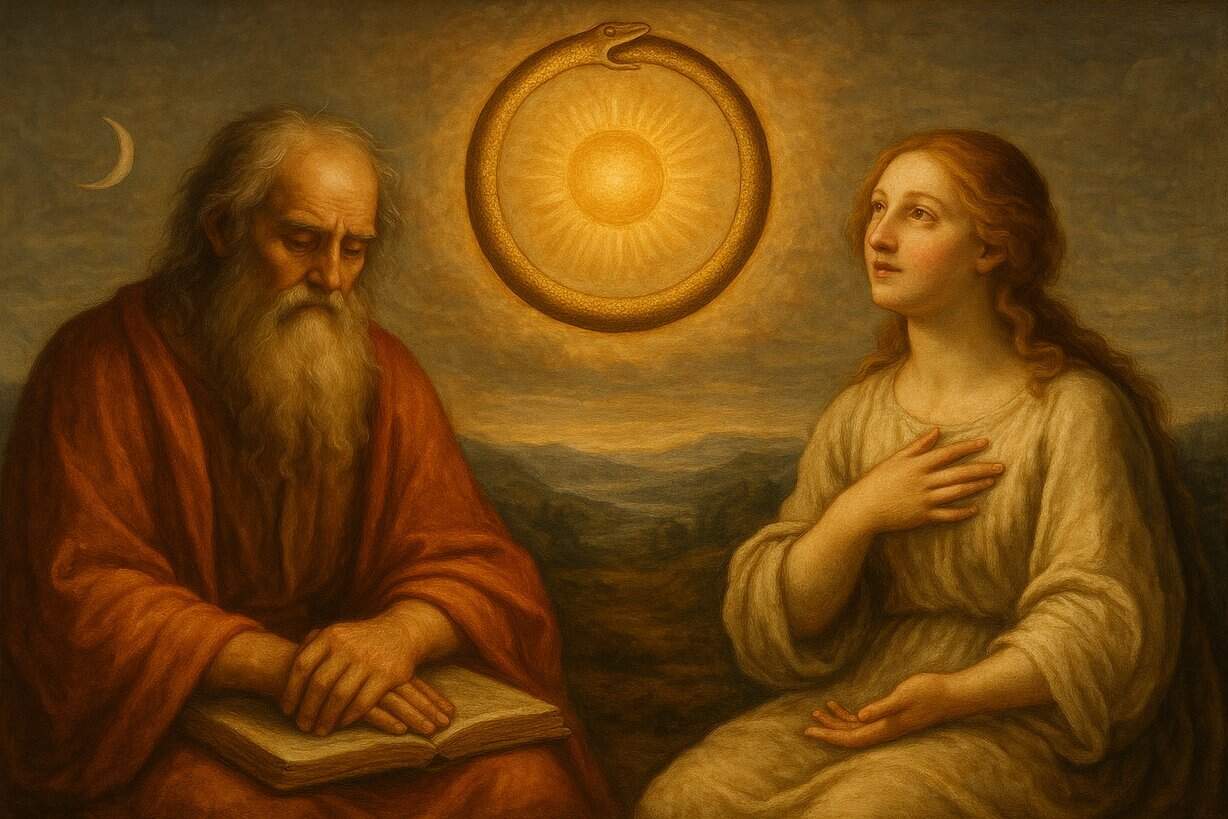
A fifth-century AD Christian Philosopher, St. Boethius, wrote the famous work The Consolation of Philosophy, still read in many Philosophy classes today. In this treatise, he writes about how his recent imprisonment and present circumstances made him unhappy, which suggested to him that he was basing his happiness upon something as fleeting and ephemeral as fortune. At this point, Lady Philosophy comes both to cheer him up but also admonish and correct him. “It is in the nature of fortune to change,” he writes. She exhorts him to base his happiness upon his true nature and upon God. Out of all his reasonings about how human life is full of change, which makes man a temporal being, he arrives at a rather famous definition of eternity. He writes, “Eternity is the simultaneously whole and perfect possession of interminable life” (Book V, Chapter vi). And this is something which God not only possesses but, in a sense, it is who God is. This is in complete contrast to the life of creatures, particularly Boethius himself, who lives life from moment to moment, which has a before that no longer exist except in memory and which has an after which is not yet and not guaranteed. The life of a creature can be fortunate in one part of life and unfortunate in another, and it is not up to him. Such is the condition of a temporal being. It is only in contradistinction to the temporal that the human mind can really arrive at an understanding of the eternal. Scholars say that this was inspired mostly by St. Augustine who writes in his confessions that God is like a king on a summit who can see before, now, and after all at once. Past, present, and future, are before God simultaneously whereas we who live in the valley of time can only see the fleeting moments of ‘now.’ However, a key principle of ‘before’ and ‘after’ is change. And since change is the measure of time, what does not change does not “travel through” time or is not subject to it.
Further, God who is the cause and creator of all things including time, Himself has no beginning or no end, which shows God transcends time. Also,there is no change for God in either the sense of accidental change (that is, little changes in detail such that a thing remains what it is, like a haircut for example) or of a substantial change (where a thing ceases to be what it is and it becomes something else entirely as in the case of, say, death). God does not change in either way and is invulnerable to all such changes. And so, God being beyond change means He is beyond time.
Given our understanding of temporality, Boethius’ definition of eternity makes a lot of sense. For creatures, the span of our life is bisected by the present “now” into the past and future. To say that God’s life is “simultaneously whole” means there is no distinction between the past and the future. God is the eternal “I AM” such that Jesus, who is God, can say in John 8:58, “Before Abraham came to be, I AM.” To be “simultaneously whole” means God’s “duration” or life is unconditioned by time, meaning God’s “future” and God’s “past” are all present in the eternal “now.” The other part of the definition is also fitting because every creature has a beginning. We can say of all things, there was a ‘time’ when they were not and when they all came to be. So, everything apart from God had a beginning or a starting terminus and also an end or ending terminus. This means that though it existed at some point it has since ceased to be. A dog ceases to be a dog when it dies. To be “interminable” means to have neither a beginning terminus nor an ending one. God again is understood to be interminable because God has no beginning or end. God always is, always has been, and always will be which is to have perfect possession of this interminable life. Angels have no end, but they have a beginning which is why they are not considered eternal in the fullest sense. In Christian theology, they are what is called ‘aeviternal’.
Distinguish between “eternal” and “temporal” or finite concepts of time.
To sum up the various kinds of relationships to time that we have discussed so far, we have discussed the eternal as altogether diverse from time, we mentioned aeviternity, a kind of temporal eternity, and lastly temporality. In eternity as diverse from time is God Himself. God alone is eternal in this sense. It can be thought of as eternity absolutely in that God simultaneously “lives life” undivided by the partitions of time such as past, present, and future. God is also not subject to change and therefore has no beginning and no end. This is what it means to be eternal in an absolute sense. Aeviternity approaches or is like eternity in that aeviternal beings like angels and saints in heaven are unchanging and live a life without end. The difference between it and eternity is that the aeviternal has a beginning as created by God. So, God can communicate a participation in His eternity through the gift of “eternal” life, which is life without end, even if it is a life with a beginning. Temporality conditions human experience as the “norm” or first principle apparent through the senses. It is by our sense of temporality that everything we see appears to change, and that things come to be and pass away. This sense of before and after, allows us to reason toward the contrast of temporality.
Christian Foundations:
The central question: “What does ‘eternal’ mean from a Christian perspective?”
In a Christian worldview, everything has meaning only in reference to God. For example, the concepts of good and evil can only make sense as defined by God. If something is good for me, that means there is a perfection for which I can strive. If there is a perfection for which I can strive I have a nature which prescribes that perfection of goodness in me. Nature acts for an end and is guided by God. Good and evil then communicates God because what is good is good for nature and evil is what is bad for nature. Peanut butter in general is good for the human being as it has protein, vitamins, minerals, and healthy fats. The individual may be allergic, in which case peanut butter is bad for that individual. Nevertheless, the reasons for which peanut butter is good (the protein, vitamins, etc.) that same individual will just have to get by other means. Again, the individual does not determine for themselves that things like protein, vitamins, minerals, and healthy fats are good for them.
The human experience of life and time gives us familiarity with the concepts of temporality and temporariness. From this, conventional wisdom gives us sayings like, “Nothing lasts forever,” “every good thing must come to an end,” or “Everything changes.” However, the naturally inquisitive among us are bound to ask whether such statements are in fact true. Is there anything at all that truly lasts forever? Is there anything that does not change? To the things that are subject to change—to those coming to be and passing away or those that do not last forever—we have “temporality.” For the non-temporal or not-temporary—we have ‘eternality.’ For the Christian, the ‘eternal’ is the contrary of ‘temporal,’ which means having the quality of not being subject to time or change. The only thing that is truly eternal is God.
The significance of the concept of eternity in Christian theology.
The Judeo-Christian scriptures reveal that the world is not eternal but has a beginning and an end. The created world is, thus, bound by time. However, this leads the philosophical and theological Christian to ponder the nature of the Creator. St. Thomas Aquinas, in his work “Summa Theologica” claims that everything we see is possible for it not to exist. However, if it is possible for nothing to exist then nothing would continue to be the case, for nothing can come from nothing. Therefore, there must be a necessary being and this being we call God. The argument rests on the “other” -ness of God as wholly diverse from contingent or possible being. And God, as the only necessary being, places him in the category of being eternal, which is without cause, beginning, or end. And so, in Christian theology, God is understood to be the only “one” that can be properly said to be eternal. Everything else is in some way bound in its existence. For the Christian, then, “Eternal” is a word that is meant to refer to how God is wholly other than creation.
Theological Foundation
The theological basis for the concept of eternity in Christianity.
Theology is a rational exploration of what God has revealed. One indisputable source of revelation is Scripture. The reason the concept of eternity finds its way into theology is God reveals Himself through scripture as eternal. From the beginning of scripture to its end, God reveals that He can be found at every time and place but is not limited to time and place either. From the first words of scripture, we read, “In the beginning, when God created the heavens and the earth…” (Gen 1:1). We do not read of the “origin” of God, because there is no beginning for God. There is only a beginning for us. What these words reveal is that in the beginning of creation, God was just there. The world did not simply exist without a beginning like God. Earth, the universe and reality, like our experience of the things in it and of our own lives, had a beginning. It came to be and had a time when it was not.
The eternity of God is also revealed in Christ who, before ascending into heaven, says, “And behold, I am with you always, until the end of the age.” In other words, God is promising to be present with us throughout the future until the end of time. And, of course, it is not the case that Jesus will just accompany us until the end of time and then we’re “on our own.” Rather, it is an accompaniment through eternity. But the implication here is that Christ will see us through to the end of time and that the “life span” of God extends beyond time itself. Only something atemporal can make such a claim and follow through on the claim.
It is significant that this occurs before the ascension and “Jesus was taken from their sight.” “Upward” is a fitting physical direction because it symbolizes the nature of God who is immanent to and transcends creation. The title of the “Most High” is an ancient title for God that even precedes the Mosaic covenant. Man, himself a social and hierarchical animal, sees a kind of social and hierarchical structure in the universe. And this is a correct vision of the world since it is how God created the world. There is order, structure, and the power to order and structure. Man has been given a measure of this power. Man has the power to rearrange matter to a degree and make the environment as he wishes but within the bounds of the physical laws of nature. This suggests to man that the intelligible laws of nature were authored by a superior or “higher” intellect, one with the concomitant power to make the law a reality. Whoever sits at the top must have an absolute power, “The Most High” who is the cause of all causes, and the power of all powers.
One of the ways that scripture provide support for the claim that God is eternal is through titles. God has been called or even says of Himself titles such as “Father forever.” The psalms really highlight and identify for us the eternal nature of God in contrast with the temporal nature of man. Psalm 90, Psalm 24, and Psalm 139 are crucial to giving voice to the understanding of God’s eternity. Notice that God’s eternity is often described in this contrast. Psalm 90 particularly writes how a thousand years are like a passing day to God. eternity is described as an exaggeration of time, but it is meant to point beyond the literal meaning of the word to the timelessness of God.
God’s Timelessness
Implications of God’s Timelessness
Christians may be tempted to believe that this presentation of God as eternal makes God “too different.” If God is eternal and I am temporal, what connects us? It seems that this creates an unbridgeable chasm between God and earthly creatures. Historically, people have taken a deist view which believes that the world was indeed authored by God but goes on to say that God designed and engineered the cosmos, set it in motion, and since then has been hands-off. However, this cannot be true for several reasons. While it is true that God has authored every nature, God is also the continuous source of every being’s power to exist and act.
On this point, St. Paul is known to have said to the Athenians that in Jesus Christ, “We live and move and have our being” (Acts 17:28). What is interesting here is that Paul is thought to be quoting Epimenides of Knossos, a writer of the 6th century B.C.—something from the Greek intellectual heritage. He is saying that it is through God’s eternity, that we exist and act temporally. God is the necessary principle for the flow of time itself. Aristotle fleshes this out in his doctrine of the unmoved mover, that every effect can be traced back to the first cause of an unmoved mover.
So, while God is timeless making God utterly transcendent, God’s timelessness also makes God utterly immanent and present to everything. This fact has interesting implications for the Christian regarding prayer and providence.
God is not bound by time or space.
God’s timelessness has the specific implication that God is not bound by past, present, or future. Rather, as scripture has revealed, God is the author of time and history, guiding the world through time according to what is called “The Plan of the Mystery” among other names. God’s providence is such that nothing happens that God did not either permit or perform. Everything that happens is accounted for in God’s plan. As we know from scripture, “For I know well the plans I have in mind for you—oracle of the LORD—plans for your welfare and not for woe, so as to give you a future of hope” (Jeremiah 29:11) and “We know that all things work for good for those who love God, who are called according to his purpose” (Romans 8:28). God alone has the power to guide and save humanity and this is in part due to his power over the course of history. This point is most poignantly made in the central Christian doctrine of salvation through Christ. It is a paradoxical mystery showing the absolute power of God that through the greatest sin of mankind where man kills his Creator in Christ, God redeems and saves mankind. This is called the Paschal Mystery. To humanity, it seems that time flows in one direction from before to after in the inevitable succession of moment after moment. Because of this death seems final. However, God shows his power over time through the finality of Christ’s resurrection. And so, being unbound by past, present, and future, God can also make a creature unbound by time and space as well. We see this at work in the life of Christ who, in His Transfiguration on Mount Tabor, was seen conversing with Moses and Elijah. Despite being from completely different time periods, they were seen together with Jesus by Peter, James, and John. Moses and Elijah themselves do not have that power; we can only assume that God made this occasion to be so. We see the same sort of power at work in the resurrection appearances. Jesus can appear anyway at any time, even “behind closed doors.” Jesus’ human nature had the quality of eternal life communicated to it such that Jesus was not bound by time or space. Because of this we can expect and hope for the promise of salvation to be fulfilled in the faithful in the same way as it is in Christ.
Human Understanding of Eternity
The difficulty of comprehending the concept of eternity for finite beings.
When it comes to understanding the nature of God, we are restricted by our own finitude. Our limitations limit our capacity for knowledge and comprehension. Any mind that is not God’s mind will fail to fully comprehend God and God’s eternity. Only God can know God fully. However, as we mentioned already, God can communicate or share his life through the conferral of grace. It is by grace that we may have the capacity and power for faith. And so, in this way, while we may not know everything there is to know in God, we are able to know some things through the gift of revelation and reason.
Our intellect can discover that God exists only through what is called discursive reasoning. As discussed above, Thomas Aquinas offered five proofs for the existence of God. Every effect is caused by something prior to it. I did not gestate and give birth to myself. So, taking this chain of causes all the way back you arrive at the first efficient cause. There is only God. God is not immediately self-evident. We begin with an observation of what we see to arrive at what is not seen. Even our language is beset and imperfect because we always have to describe God in terms that are in contrast with what is more evident to us, which is what we can see, hear, smell, taste, and touch. Thomas Aquinas noticed this about our speech and reasoning about God and says that the only real way in which we can do the act of theology is by this negative reasoning. To say God is infinite, for example, is to say that God is ‘not finite’ or without a boundary. To say that God is eternal can only be described by us as not being temporal. Notice this is not a positive affirmation of some quality in God, but proclaims Yahweh is unlike anything material or finite.
How did theologians and philosophers grapple with the idea of eternal existence?
Prior to Christianity, as in the philosophers and poets of Greece prior to contact with the idea of monotheism, they would often conceive of the divine as being like human beings, just superior. This anthropomorphizing of the divine skews human knowledge to understand the eternal only partially. In this view, gods are still subject to time and have a cause or beginning, but they have an unending life. So ‘eternal life’ only meant immortality. It is Aristotle and Plato who began to question this conception of the divine and what “eternal” means. In speaking of the eternal forms, Plato adds to the definition of eternal the concept of unchanging and timeless.
Throughout Hebrew and Christian scriptures, psalmists and prophets spoke of the transcendence and omnipresence of God. “If I ascend to the heavens, you are there; if I lie down in Sheol, there you are” (Psalm 139:8) and “For as the heavens are higher than the earth, so are my ways higher than your ways, my thoughts higher than your thoughts” (Isaiah 55:9). In relation to time, the psalmist writes, “A thousand years in your eyes are merely a day gone by” (Psalm 90:4, cf. 2 Peter 3:8). These are verbal gestures at the concept of the eternal nature of God.
More precise language would come together throughout the life of the Christian Church through the words of St. Augustine, St. Boethius, and St. Thomas Aquinas. St. Augustine for example famously gives the mountain top analogy mentioned above, that God stands outside of time with no beginning nor end, but God looks upon all of time simultaneously. This would be highly influential on Boethius who largely follows Augustine and who gives the definition: “the simultaneously whole and perfect possession of interminable life.”
How Christians approach the mystery of God’s eternity in their faith.
God is utterly diverse from any and every creature. There are many one-way facets to our relationship with God. We depend upon God; God does not depend upon us. We owe thanks to God for everything He gives us, God owes us nothing. God creates us, but God Himself is uncreated. In view of this reality of God, Christians are then bound (this is where we get the meaning of ‘religion’ from, religare) to act and order their lives accordingly.
It is an act of worship to acknowledge and accept the eternity and infinitude of God, and a further one to proclaim and profess such a God. One of the hopes of the author of this response is that having unpacked the meaning of eternal gives readers a sense of the profound majesty, splendor, and glory of God. To praise and worship God, according to Hesychius, is to proclaim the deeds of God. To see, make known, and celebrate God and His deeds is at the heart of worship. One of the important aspects or acts of God is God’s eternity. It is by His eternity that God creates temporal creatures such as us.
The ultimate end of the Christian life is the glory of God through our union with Christ. All our prayer, strivings to be virtuous, and acts of worship are meant to be aimed at evermore bringing us to closer and closer union with God such that we reflect the relationship of the Father and Son in the Trinity—so that we may say with Jesus, “The Father is in me as I am in the Father” (Cf. John 14:11). An effect of union with God is to grow in likeness to God. A part of this growing in likeness then is to be given a share of eternal life.
Eternal Life and Salvation
In Genesis 3, Christians understand this event as the original sin and fall of mankind. It is the Christian explanation of the human condition which is less than ideal. It is not due to God’s failure to make creation perfect but because of humanity’s rejection of God’s order that man sinned and found himself in the situation that he was in. The Jewish tradition even sees this moment as the event in which death entered the world (see Romans 5:12 and Wisdom 2:24). Reasoning backward, Adam and Eve were in a state of preternatural justice—an ordered state in which man lived as God intended and included a kind of everlasting life. It was a kind of life without end but in time and subject to change. Being subject to death is considered a consequence of the fall.
This fallen state is constituted by a tendency to sin in every relationship, that is, in relation to us, to one another, to our environment, and to God. Mankind cannot help but be self-destructive. A sign of God’s love for us, however, is that God did not “leave us orphans” (See John 14:18). Even as far back as Genesis 3:15 (the promise of enmity between the offspring of the woman and the offspring of the serpent), there can be seen God’s providential promise to save us from our sin, that is, to save us from the consequences of our sin.
Jesus reveals Himself to be, “The Way, The Truth, and The Life” (John 14:6). And Jesus reveals this about Himself together with the revelation that He is God, the Word made flesh (John 1:1). The reason God needed to become one of us, as the Church Fathers often wrote about in the first few centuries after Christ ascended into heaven, is that humanity was in a bit of a bind. It was humanity that needed to make up for the sin it committed but humanity did not have the power to do so. Thus, the Son of God became a human being to do it in our place. Paul is quite explicit in this regard saying, “For just as in Adam all die, so too in Christ shall all be brought to life” (I Corinthians 15:22). And the character of this life is not just a continuation of earthly life, but it will be to a new and eternal life in heaven. What is it that God has that human beings sorely lack? Eternal life. And so, God’s Son, “emptied himself” (Philippians 2:7) and became a mortal human, so that the way might be opened and that we might be filled with God’s eternal life. Jesus brokers a “new and eternal” covenant. This is a covenant that fulfills all the promises of life made to our “fathers”: Abraham, Isaac, Jacob, and Moses.
Eternal Consequences
The fundamental Christian doctrine of the mission of Christ, that by His suffering and death, we might be saved, raises the question of for whom is eternal life given?
Many Christians find the truth in God’s judgment, as Scripture tells, will be based on our life’s decision which itself is based on our deeds. Jesus says that in the end, “When [He] comes in glory,” there will be a judgment where the saved will go to His right and the damned will go off to his left, where they will be cast into the “eternal fire prepared for the devil and his angels.” “And these will go off to eternal punishment, but the righteous to eternal life” (Matthew 25:41, 46).
The idea here is that once a decision has been made, there is no change. There is the accursed eternity of hell which is ultimately an eternal separation from God and subsequently from our happiness and fulfillment; or there is the eternity of the blessed and righteous consisting of eternal union with God. While the judgment ultimately resides with God as to who merits where, God does give us the criteria upon which He judges revealed in scripture. The two greatest commandments are to love God and love your neighbor as yourself (Mark 12:28-30). Further, Christ says, “If you love me, you will keep my commands” (John 14:15). The choice then is to love God by following the commands He gives as given in scripture and understood by the Church through the way one lives their life, or to willingly disobey.
Human beings, though they live in time and space, have special souls that “touch upon” eternity, namely that their souls are made in God’s image having intellect and free will. Although we might reason and act in time and space through our bodies, our immortal souls, in a sense, already live in eternity. The point of life is to make this choice and strive to live as God made us to be, which is in accord with His will, or do we follow the fallen angels and say, “Not your will, but mine be done.” This is ultimately just because God, who can see into our heart of hearts, can determine the choice. To a certain extent, ignorance is a mitigating factor, there are implicit acceptances and rejections of God to be found in the various acts and ways of living.
Eternity and Worship
Eternity is very much a proper “attribute” of God—something identical to God’s essence. So, coming to know this fact, eternity is a frequent and fitting theme of worship, so much so that, in scripture, heaven is conceived as the endless and continuous (as opposed to continual) worship of God (cf. Rev. 4:8). The object of worship on earth is to reflect what is often called the “heavenly liturgy.” This is essentially what we mean when we pray the Lord’s Prayer: “…Thy will be done on earth as it is in heaven” (see Matthew 6:5-15). If heaven is where God’s will reigns and where God is continuously worshiped and praised, Jesus expresses through the prayer He teaches us that we too ought to continuously worship God and let God’s will reign in us and in the world. It is this understanding of seeking to make the earth “as it is in heaven” that is behind Jesus’ teaching to “pray unceasingly” (Luke 18:1). Every day, every year, and, indeed, every moment is meant to be devoted to and aimed at glorifying God. And this is all considering the eternity of God.
Conclusion
In sum, ‘eternal’ is only properly said of God, which has the quality of “the simultaneously whole and perfect possession of interminable life.” God is eternal because God is the uncaused cause of all that is and himself, has no beginning or end, has no before or after, is timeless, and is perfectly invulnerable to change. This contrasts with what is temporal, which has all the contrary defects: is caused by something “above it,” has a beginning and an end, has a before and after in time, and can be changed substantially or accidentally. However, there are degrees or participations of eternity that God can communicate to creatures. The human soul is immortal and by the living of life makes the eternal choice to live the eternal life of the blessed in heaven or the eternal punishment of hell. Salvation is characterized by God’s communication to those whom he judges to merit eternal life in union with Christ in heaven. Though the human being and the human soul are creatures of God, they can be like the angels and granted a share in eternal life in heaven. And so, this hope, made available to us through the saving death and resurrection of Christ, then ought to shape our life and the decisions made within it in accord with God’s will so that we may be found worthy of eternal life. Only a life of righteousness and love of God and neighbor which is in accord with God’s will is compatible with eternal life. Sinfulness, which is the rejection of God’s will and the favoring of our own in opposition to it, is incompatible with an eternal life of happiness with God since God is our “only good” (See Psalm 16:2. See also the rest of Psalm 16 especially, verse 11).
The knowledge of God’s eternity should fill us with both awe at the majesty, power, and greatness of God but should also fill us with a holy desire, longing, or jealousy. Seeing our own wretched state, living a life of “nothing” where “there is nothing new under the sun” (cf. Ecclesiastes 1:2-3), where we walk “in the valley of the shadow of death” (Psalm 23:4), and where we are aware of the shortness of our life (Psalm 90:10); man will naturally desire a life like God’s. As St. Augustine noted, “Our hearts are restless until they rest in Thee.” We were made for eternal life and so it is in our nature to desire it especially since sin puts us in a position where we are “cut off” from such a life. The worldly pursuits of life such as the pursuit of wealth, power, honor, fame, and the like are just the shadows of the true happiness found in God alone.
About Post Author