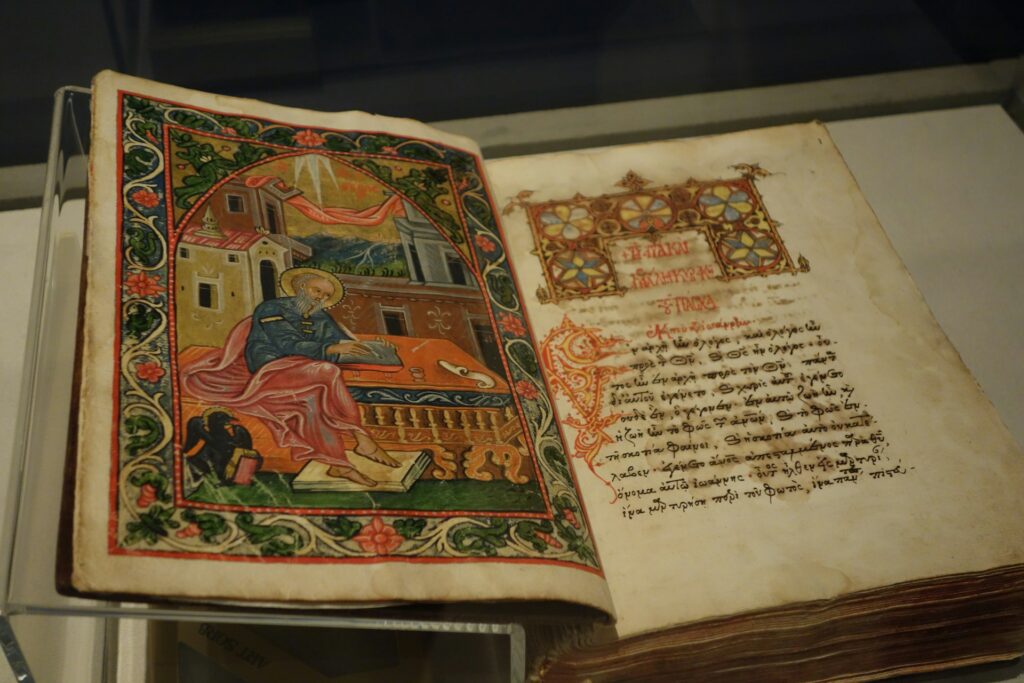
Codex H has yielded 42 recovered pages, reshaping what scholars can read today. An international team restored the lost material using multispectral imaging and carbon dating. The work centers on a sixth-century Greek manuscript containing St. Paul’s letters. Garrick Allen, a University of Glasgow professor of divinity and biblical criticism, led the project. The discovery links modern Bible readers to earlier generations by showing that they, too, wrestled with Scripture and marked it up.
Monastic Notes Add Prayers, Poems, and Personality
Monks at the Great Lavra Monastery on Mount Athos filled margins with poems, prayers, and reflections. Those notes give intimate glimpses of unnamed lives and private devotion. Allen highlighted one small Byzantine poem that turns playful but stays pointed. It urges Plato and Plutarch to be silent before Basil the Great. And it signals confidence that monastic reading stood alongside the Greek classics.
Ancient Tools Organized Paul Long Before Modern Chapters
Codex H also preserves one of the earliest-known examples of the Euthalian Apparatus. That system used chapter lists and headings to structure Paul’s letters. The recovered material includes lists that diverge from modern chapter divisions. So it shows how sixth-century readers navigated the text without today’s chapter-and-verse framework. The results also underline how scribes corrected and compared copies to refine wording.
Recycling Parchment Scattered the Manuscript Across Europe
By the 13th century, Codex H had been disbound, likely because wear made it hard to read. Parchment costs money, but monastic libraries reused old sheets as bindings and flyleaves. Pages were retraced in fresh ink to preserve them, then folded into other volumes. That process dispersed pieces across libraries in Italy, Greece, Russia, Ukraine, and France. But it also created a faint, mirrored transfer of ink onto facing pages.
“Ghost” Text Rebuilds Missing Leaves, and Debate Follows
That mirrored transfer left “ghost” outlines that remain barely visible. Multispectral imaging revealed those traces, and researchers reconstructed multiple pages from a single leaf. The technique recovered roughly 50% more content, including text from pages that no longer survive. It also preserves about 100 annotations and corrections that map ongoing efforts to secure the right text. Supporters say the Codex H pages prove Scripture was used, and they value the human voices in the margins. Detractors worry that the emphasis on flux could unsettle believers, but the team stresses that no new biblical passages have emerged.
About Post Author