
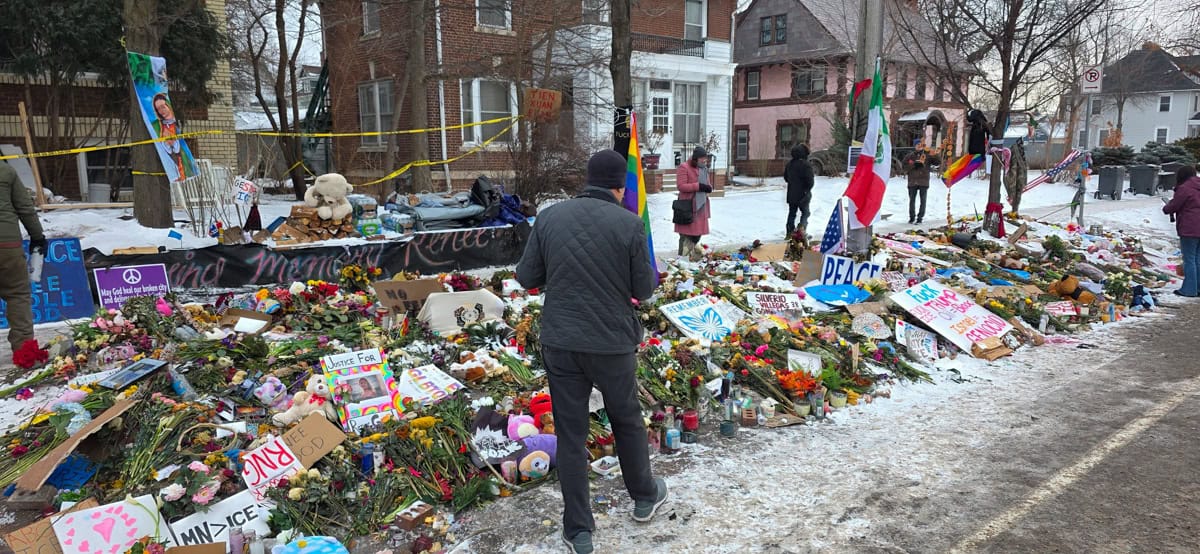
This past Friday, I received the following message from Molly Steenson, CEO & President of the American Swedish Institute, my neighbor and venerable Twin Cities institution, which is ten blocks from the murder site of Renée Nicole Good, which in turn is six blocks from the murder site of George Floyd, and nine blocks from the site of the murder of Alex Jeffrey Pretti.
A Missive from the American Swedish Institute
For nearly 100 years, ASI has welcomed, celebrated, and studied immigration. ASI is a place created by immigrants and has transformed into a welcoming place that inspires curiosity, embraces creativity, and grows community by exploring the past, present, and future.We are a safe space for learning and connection, especially in moments like these, when our neighborhood needs it most. ASI stands with our community in Minneapolis, the Twin Cities, and Minnesota, now and always.
On Friday, January 23, ASI will join organizations in Minneapolis and beyond who are participating in a day of action and reflection in response to increased ICE activity in our community by closing for the day. ASI staff are encouraged to participate in whatever ways feel most meaningful to them.
We invite you to join us in supporting our local community. If we can answer any questions, please don’t hesitate to reach out.
Best wishes,
Molly Steenson
CEO & President, American Swedish Institute
A Kinder Nation
While I appreciate friends’ heartfelt concern about how all of this may be affecting my own life, the more urgent question is how it is affecting my neighbors. If the federal government were genuinely concerned about immigration, targeting perceived symptoms rather than underlying causes would not be the approach. What this moment reveals instead is an ICE apparatus that operates through fear and division rather than safety—and a stark departure from George H. W. Bush’s 1988 call for a “kinder, gentler nation,” a vision that now seems largely abandoned.
As a dedicated public transit user for the past 13 years, I find that immigrants are the least of our worries. Additionally, it isn’t difficult to find studies showing that immigrants do not increase crime rates. Along with the research of the American Sociological Society, which has done some excellent work in this area, a good starting point are two PBS NewsHour broadcasts: “As Immigration Rises, Violent Crime Falls or Stays the Same,” April 1, 2018, and “Fact Check: Immigration Doesn’t Bring Crime into U.S., Data Say,” February 3, 2017.
Both of these documentaries summarize sociological and criminological research showing that immigrants—including undocumented immigrants—are less likely to commit crimes than native-born Americans and that higher immigrant presence in communities is associated with stable or lower crime rates. A problem with the documentaries for millions of people, however, is that they were produced by PBS, which according to Project 2025’s Mandate for Leadership, “do[es] not even bother to run programming that would attract conservatives.” A telling statement, and not particularly complimentary to conservatives. This document, incidentally, was a strong impetus for the federal government to discontinue its support for public broadcasting.
Migration Multipliers
But taking a look at the larger picture, according to the Migration Policy Institute, the planet is living in one of the largest periods of global migration in history: record numbers of people are on the move both across borders and within their own countries, driven by conflict, violence, persecution, economic pressures, and environmental change. As of 2024 – 2025, an estimated 304 million people live outside the country where they were born, nearly double the number in 1990. And the global migrant stock continues to grow.
At the same time, forced displacement has reached unprecedented levels — with over 122 million people uprooted by violence and persecution alone, a figure that has roughly doubled over the past decade and represents about 1 in every 67 people on Earth. These trends show that human movement today is larger in absolute scale than at almost any point in modern history. People migrate primarily when remaining where they are becomes life-threatening rather than merely difficult. The most powerful drivers are violence and the fear of being killed—through war, political persecution, or unchecked criminal violence—and starvation or extreme deprivation caused by economic collapse, failed states, or environmental stress.
Climate change, which, according to the Trump administration doesn’t exist, increasingly intensifies these pressures by destroying livelihoods through droughts, floods, and rising seas, often triggering both hunger and conflict. The breakdown of basic services such as healthcare, education, and public safety further erodes the possibility of survival, especially for families trying to secure a future for their children. While “pull factors” like jobs or family ties abroad influence where people go, migration is overwhelmingly a response to existential danger: most people move not to improve their lives, but to preserve them.
Safeguarding a Political Weapon
If this sounds obvious, it is because it is—and it bears repeating. The bipartisan Border Act of 2024 (S. 4361) offered a workable legislative path forward, supported by 41 Democrats and one Republican, Senator Lisa Murkowski of Alaska. Her support stood in direct defiance of the presumptive Republican presidential nominee, who urged the bill’s defeat not on policy grounds, but to preserve immigration as a campaign weapon. That deliberate choice—to sacrifice governance for political theater—did not occur in a vacuum. Its consequences are now playing out in Minnesota, where a manufactured crisis has replaced reform and performative enforcement has eclipsed public safety.
The border act would seem to be a clearer vision than the resultant platform, which appears to focus on bringing in poorly trained vengeful federal agents who are working under the guise of rooting out dangerous foreign-born criminals (directed by an administration who is being led by a convicted felon who has yet to come clean about trying to illegally upend the 2020 election and whose idea of power is to take over Venezuela and Greenland, build a ballroom, cut billions of dollars from K – 12 and university programs as well as $2.3 billion from National Institutes of Health and $700 million from the National Science Foundation, and $1 trillion from Medicaid—only to reduce the same amount in taxes for the top 1%, and withdraw from 66 international organizations including the World Health Organization. But I digress). While various reports indicate that up to 3,000 arrests have been made in the past few weeks in Minneapolis, the categories and details aren’t clear (some estimates suggest about 5% are violent criminals, with the rest having nonviolent convictions or no convictions at all). Given the administration’s track record of targeting cities and leaders who challenge its policies, the focus on Minneapolis appears politically motivated—particularly since Minnesota has a comparatively low percentage of foreign-born residents. Depending on the year and month, Minnesota ranks roughly 23rd nationally, undermining claims that immigration pressures alone explain the intensity of federal action.
Targeting the Opposition
Consequently, it is not much of a leap to conclude that Trump’s defeat of the Harris–Walz ticket helps explain why cities in Governor Walz’s Minnesota have become particular targets of his wrath. With red Texas having a considerably larger percentage of foreign-born residents than Minnesota, I’ll be interested to see if it becomes an ICE target.
One of Donald Trump’s most consistent traits is that winning doesn’t lead to magnanimity. Instead of pivoting to unity or even a quiet victory, he often continues to frame former opponents as illegitimate, weak, corrupt, or dangerous, even after defeating them. Obama was still the target of “birtherism” even after leaving office; Biden and Harris are still routinely mocked and delegitimized; and figures like Walz get folded into the same narrative once they’re symbolically useful.
Feeding a Political Frenzy
Psychologically and politically, this serves a purpose: perpetual conflict keeps his base energized. Acknowledging opponents as worthy or respectable would undermine the core message that only he is legitimate, and everyone else is either incompetent or malicious. In that sense, victory doesn’t end the fight—it just shifts the terms.
Many supporters see this not as bitterness but as “strength” or “telling it like it is,” while critics see it as corrosive to democratic norms. Either way, it’s remarkably consistent—and historically unusual—for an American political figure to keep campaigning against people he has already beaten.
A Lack of Support
It might also be noted that citizen protests are protesting ICE; they aren’t protesting citizens who support ICE. The reason for this, of course, is that any local citizens who support ICE are remaining quiet. Consequently, public reaction in Minneapolis and St. Paul to the presence of federal agents has been overwhelmingly negative, marked by fear, protests, business closures, legal challenges from state and city leaders, and support for protests from landmark institutions like the American Swedish Institute. While some national political figures support the deployment, there is little visible local support within the city itself. So, who supports ICE’s presence in the Twin Cities? Trump supporters who live elsewhere and keep believing him.
While this piece was going to press, I received a message from the Minnesota Music Educators Association: The in-person 2026 Midwinter Convention and all associated events are canceled. The reason is simple — in a city where federal enforcement operations have already cost lives, it’s no longer safe to gather students, educators, and families. Music, it seems, must now compete with bullets and barricades for a place in public life.
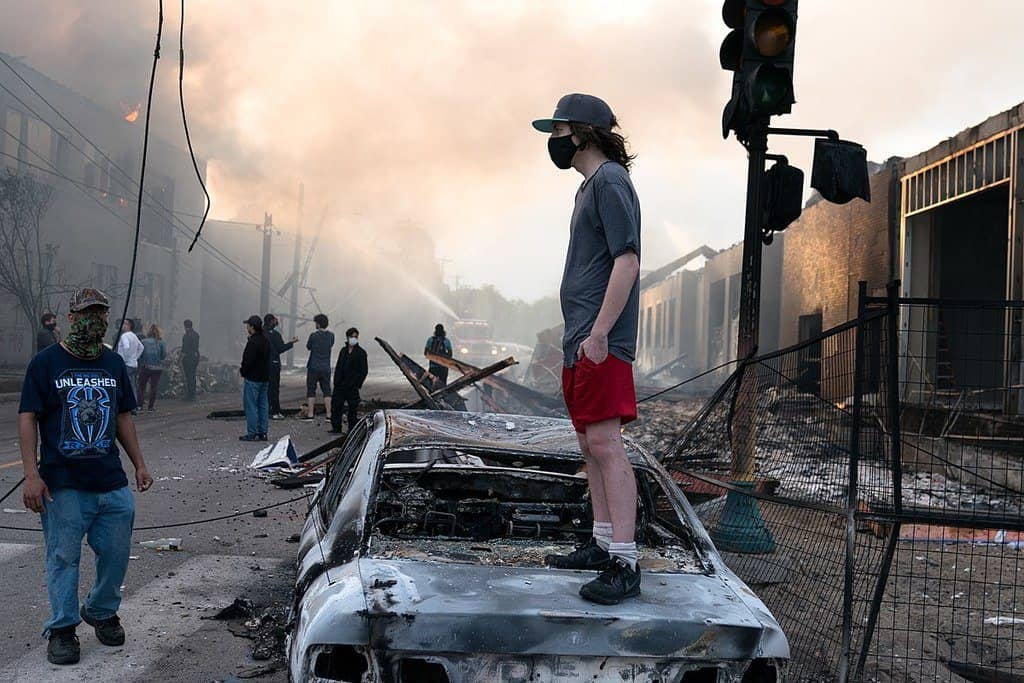
Image: James Gottfried
About Post Author



Dr. Gleason, your thoughts are brilliant, wise and compassionate. Thank you. Jane Burg
Thank you Mrs. Burg. Here’s to sanity.