There is a muted wistfulness in Springfield, Illinois, that always seems to be hiding just below the surface of this town. Springfield possesses a kind of elegiac beauty, as though the city has learned to make peace with its own melancholy. Candy and I have been here for just over two years now, after I accepted a position as an oral historian at the Abraham Lincoln Presidential Library and Museum. There are beautiful days here, certainly, when the prairie sky opens wide and blue over central Illinois, but there are also long stretches when everything seems to settle beneath a ceiling of gray. The clouds hang low, the wind moves across the flat landscape with almost nothing to slow it down, and winter can make the whole city feel as though someone has turned down the saturation. No wonder ole Abe Lincoln struggled with debilitating depression at times. Obviously, not all of this can be reduced to Illinois weather, yet if you spend enough gray afternoons here, you begin to understand the aesthetic a little better.
I am writing this in August, and August tells another story about Springfield.
Summer in Springfield Tells a Different Story
Summer here can be thick and heavy. The humidity settles over the prairie, cicadas provide the soundtrack, and the corn surrounding the city has grown high enough that the landscape feels completely different from the barren fields of winter. The Illinois State Fair comes alive with livestock, carnival rides, concerts, political speeches, fried food and more people than you thought Springfield could possibly hold. Springfield even claims a place in the disputed lore surrounding the invention of the corn dog, with the “Cozy Dog Drive In” serving its battered, deep-fried hot dogs on sticks along old Route 66 since the 1940s.
Then there is the horseshoe, Springfield’s wonderfully excessive contribution to American cuisine. The basic architecture is gloriously uncomplicated: Texas toast topped with meat, buried beneath a pile of French fries, and then covered in cheese sauce. It is the sort of meal that makes you understand why moderation has become a virtue.
Summer evenings stretch out slowly here, and when the sun finally begins to drop, the sky can become enormous. Pink, orange and purple spill across a horizon largely uninterrupted by mountains or skyscrapers. For all the gray days Springfield gives you, it occasionally offers a sunset that feels like an apology.
There is also an understated beauty here, particularly in what is old. And “old,” of course, is relative. Our Republic has just celebrated its 250th birthday, which means most of what Americans call ancient would barely qualify as middle-aged in much of the world. Still, Springfield celebrates what is old. Old houses. Old buildings. Old neighborhoods. Old institutions. Old stories. Sometimes I think the city is almost suspicious of anything too shiny or new.
An Old Church in a City That Loves Old Things
I suppose that affection for old things may be part of what attracted me to one of Springfield’s older congregations, Central Baptist Church, located downtown directly across the street from the Governor’s Mansion. I was introduced to Central by a friendly volunteer here at the library, who has worked with me on oral history projects. His name is Ferrell, and he has spent much of his career as a journalist and editor for Baptist publications in both Texas and Illinois. It was Ferrell who first invited me to Central and eventually introduced me to Pastor Tony Stang.
A Pastor Always Asking What Comes Next
Tony is difficult to miss. He towers over me, a big, athletic guy who played football in high school and still carries himself like someone who wouldn’t mind lining up for another snap. These days some of that competitive energy gets spent on pickleball. He has led leagues here in Springfield and seems determined to involve himself in just about every corner of community life he can find.
But physical presence isn’t really what makes Tony noticeable. It is the kinetic energy he carries with him. Talking with him can be an adventure because his mind always seems to be moving. One idea leads to another, which opens the door to another possibility, which reminds him of somebody he needs to call. He is constantly thinking about what the church could do, whom it could reach, where it could show up, and how it could become more deeply embedded in the life of Springfield.
He is also a devoted husband and father. He and his wife, Lindsay, are raising three children, while Lindsay leads a clinic devoted to meeting the pediatric therapy needs of families. There is something about knowing that part of their story that helps me understand Tony’s vision of ministry. Faith, for him, seems most interesting when it becomes tangible, when it leaves the sanctuary and enters the ordinary places where people actually live.
His sermons carry much of the same personality. They are short and conversational, sometimes wonderfully meandering, less like formal theological lectures and more like listening to someone think out loud about a biblical text. Tony will pull a relatively simple idea from scripture and then spend his time asking what that idea might look like when carried into twenty-first-century life. There isn’t much pulpit theater to it. He tells stories, wanders down the occasional side road, asks questions and eventually brings the conversation back around. After spending a significant portion of my life around preaching that seemed determined to provide an answer before anyone had finished asking the question, I have come to appreciate sermons that leave a little room for wondering.
That spirit of curiosity matters because Central itself seems to be living inside an interesting transition.
When an Aging Church Makes Room for Something New
Like many historic downtown churches, it has an aging congregation. The people who have loved Central for decades have also provided it with something increasingly rare among churches its size: financial legacy support. Generations of faithful members have left behind more than memories. Their generosity has created resources that give the congregation some breathing room to ask what its next chapter might look like. There is something beautiful about that. People who may never meet the next generation are still helping provide a table for them.
And increasingly, some of the people finding their way to that table are younger artists.
That contrast fascinates me. An aging congregation, supported in part by the generosity of generations past, is slowly being joined by younger people who act, sing, direct, design and create. A surprising number of them are connected to Springfield’s musical theater community. In another church, or under another kind of leadership, those two groups might simply occupy opposite ends of the sanctuary. At Central, there seems to be an emerging possibility that they might need one another. And I’ve watched them live out this possibility with love most every Sunday. A resilience that is needed by congregations and artists alike.
The Stubborn Creativity of Springfield
Springfield has a stubborn arts community, and I mean stubborn as a compliment. Not stubborn because the quality is lacking. Quite the opposite. Stubborn because there is a tenacious insistence here that art deserves to exist whether Chicago, New York or anyone else is paying attention.
People act. They sing. They paint. They build sets. They rehearse after work. They gather in old buildings and tell stories beneath stage lights. They keep making beautiful things because making beautiful things is worth doing. There is something wonderfully defiant about that, particularly in a city where gray skies and government bureaucracy could easily convince everyone to become accountants.
Increasingly, I think that same stubborn creativity describes Pastor Tony. He has the disposition of an artist who also happens to pastor a historic American Baptist church. That creates an interesting tension because Central carries the weight of generations while Tony seems constitutionally incapable of not asking what could happen next. How do you honor what has been without becoming imprisoned by it? How do you preserve memory without turning the church into a museum? How do you love the people who built the institution while leaving enough empty chairs for people who haven’t arrived yet?
Come to the Table
Last evening I sat across from Tony at a local restaurant Central had rented out for the evening. We weren’t there for a typical church service. It was essentially a practice run for a new outreach initiative called Come to the Table. The idea is almost suspiciously simple: invite people to come, give them a free meal, sit around tables together and hear a Jesus story.
That’s it.
And maybe that’s enough.
There is something almost ancient about that idea. Christianity, after all, was born around tables as much as it was born behind pulpits. Jesus seems to have spent an extraordinary amount of time eating with people, particularly people respectable religion wasn’t always sure belonged at the table. Perhaps churches don’t always need another program. Maybe sometimes they need some food, some stories and enough empty chairs for whoever happens to walk through the door.
Making Room for What Comes Next
Maybe that’s why Central has become interesting to me beyond simply being another church. It sits at the intersection of so many things I find myself thinking about these days: history and possibility, memory and imagination, preservation and change. The resources of yesterday are helping make room for people who may imagine tomorrow differently.
In that sense, Central feels very much like Springfield itself.
Springfield isn’t glamorous. It doesn’t particularly care whether you think it is. It is gray February afternoons and humid August evenings, prairie winds and cicadas, horseshoes and corn dogs, Route 66 and musical theater, state politics and old churches, Lincoln and complicated histories that stretch far beyond him. It is a city that remembers the past while quietly trying to imagine what comes next.
And perhaps that is what I’m beginning to appreciate about this place. Springfield rarely demands your attention. You have to stay long enough to notice it.
Sometimes beauty here arrives slowly. Sometimes it survives because somebody from another generation thought far enough ahead to leave something behind. Sometimes it appears beneath stage lights in a small theater. Sometimes it shows up around a restaurant table with a pastor dreaming out loud about feeding strangers.
And sometimes, after several days of gray, the clouds finally break over the prairie and the whole place is flooded with light.
And maybe, just maybe, you appreciate the light a little more after you’ve learned to live with the gray.
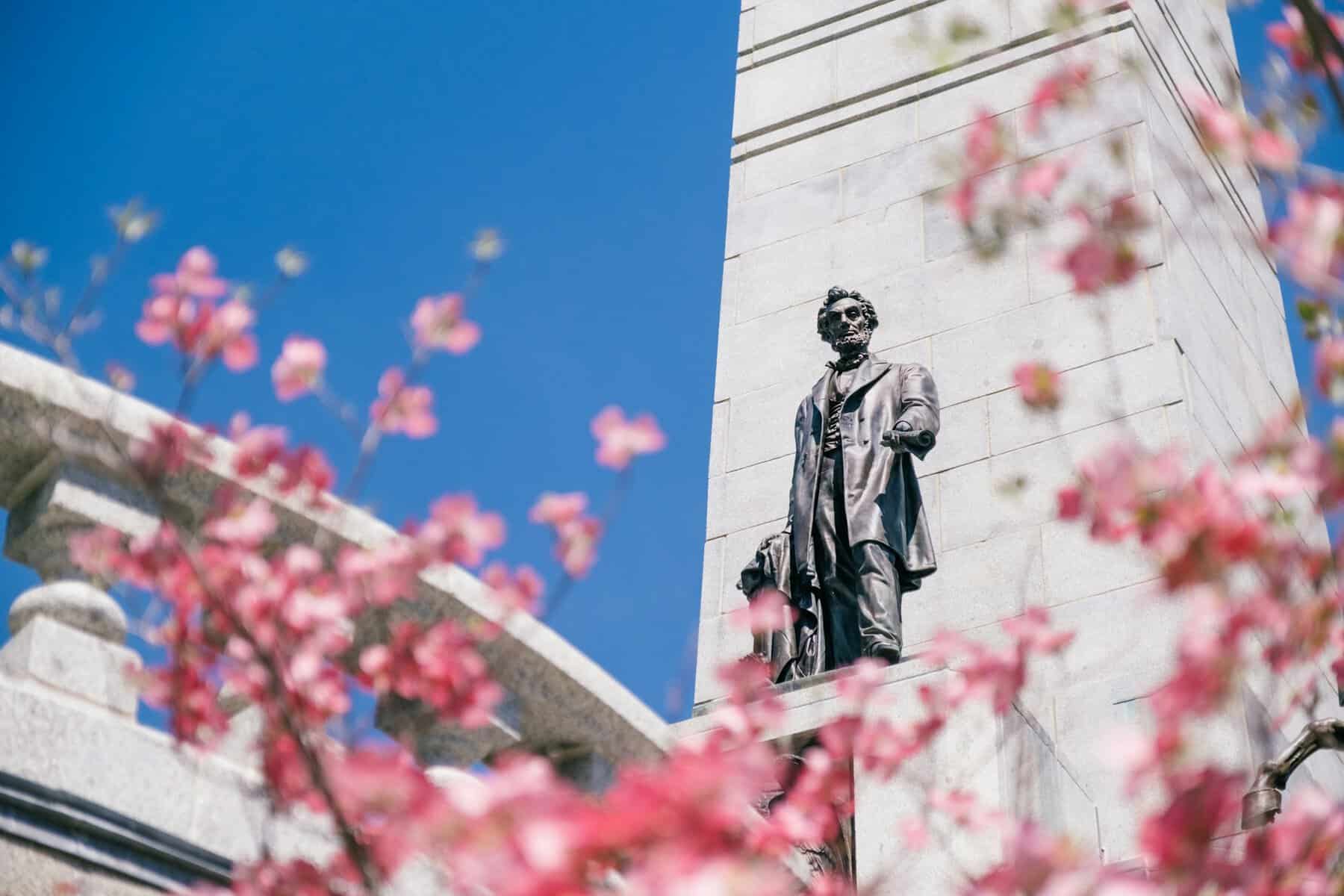
Photo by Patrick Robert Doyle on Unsplash
About Post Author