
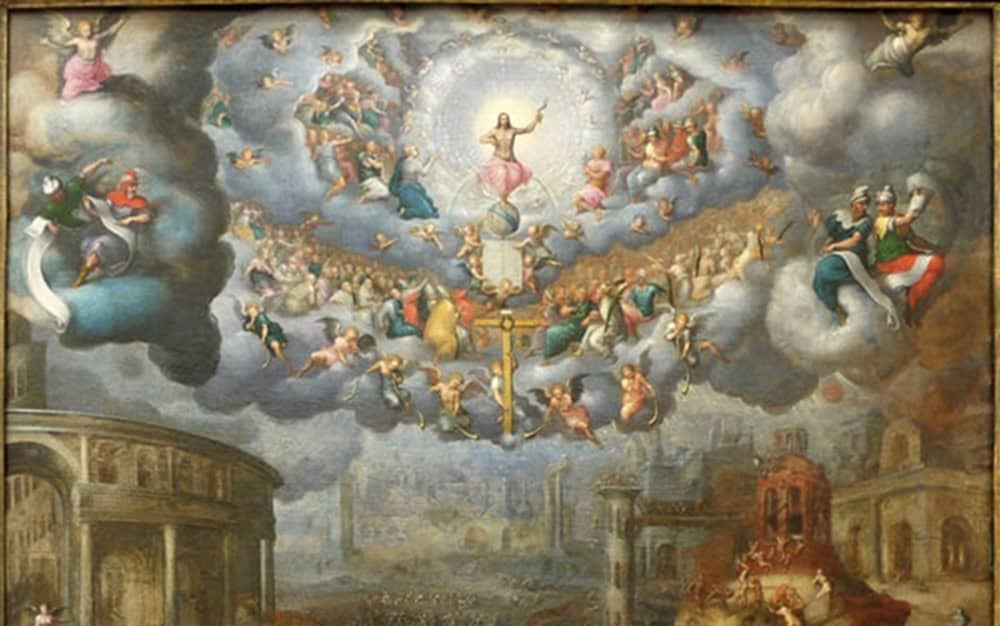
Like most people, I did not get Raptured on Rosh Hashanah.
At this point, I have not been a part of a Rapture-emphasizing tradition for more of my life than I was, but I came of age during the lead-up to the turn of the millennium, so in some ways I could not have avoided exposure to the idea. Many, many people had predicted that the end of the age would coincide with the year 2000 – whether through technological apocalypse vis-à-vis the Y2K bug or because of Christ’s imminent return – and most of the young people in my church read at least some of the Left Behind literature. Whole publishing industries dedicated to decoding Biblical symbolism and contemporary news events as signs of the times proliferated, mutated and in some instances generated doomsday cults in those years. DC Talk even recorded a terrible cover of Larry Norman’s “I Wish We’d All Been Ready”.
Fear and Faith in the Late 1990s
By the time the late 90s wound their way into the early aughts, the discussion reached a fever pitch and then peaked, giving me and my friends alike a strange set of neuroses, apprehensions and nightmares about family members and pets who would not make the cut before the Great Tribulation began. And what if we were not truly believers ourselves? What would happen to us?
As a bookish youth and later religion student at a small Christian college, I eventually concluded that the story being told about what the future would look like did not make much sense in light of what the scriptures actually said. Yes, I affirmed – and affirm – the words of the Bible and the Creeds that say Christ will return, but I made that affirmation without the complex system of theological stretching and cross-referencing that, for some people, approaches trying to divine sacred Q-drops.
When the End of the World Went Quiet
Strangely, after the events of September 2001 in the United States, the conversation about the end of the world became more muted in my circles as the world order as we knew it was restructured into the Global War on Terror, the invasion of Iraq, the global financial crisis and a renewed wave of culture war activity. Some commentators, influenced as much by the secular press as any sincere but misguided reading of the scriptures, briefly identified Barack Obama as a candidate for the Antichrist, but by the time he left office people weren’t talking about the Rapture very much.
I personally know people who were sure God had told them that Jesus would come before a certain year, years that are now a long way in the rearview mirror. And history is littered with similar such cycles, from the 1970s, to the failed predicted Raptures of the 1930s and 40s, to the Millerite disappointments of a century earlier, to Cotton Mather’s three failed predictions in the 1690s and early 1700s.
And of course those are just a very, very few of the American examples. Church history is littered with failed attempts at guessing when Christ will return. The Black Plague era was ripe with predictions, as was the fall of the Roman Empire — and basically any other period of social upheaval, across any culture with a Christian presence. Even the earliest generations of Christians believed it would happen at any time, which is what some of the passages in scripture that people are desperately trying to interpret today were addressing for their contemporary audience. “No one knows the hour” has proven brutally blunt and truly evasive.
RaptureTok and the Return of End-Time Hype
That’s why, when the idea of #RaptureTok took off in the last week of September, my inclination was to grin and respond, “First time?” But as the dates approached and the discussion seemed to spread further and wider than a few people trying to offer reasons about why such predictions are historically illiterate and are predicated on bad theology and questionable sources (the pastor who made the prediction said it came to him in a dream), I became increasingly baffled at the number of people who were seemingly buying in, not as a joke, but out of hope. People shared videos of themselves having called in sick to work, singing praise songs in anticipation, and making sure they were dressed in what they thought were appropriate clothes for meeting Christ. One woman, in apparent complete sincerity, said she was holding off going to the bathroom so that she wouldn’t accidentally be on the toilet when Christ arrived.
Rosh Hashanah, the supposed date everything would happen, came and went without the return.
Notably, like many others who made failed predictions, the man who inadvertently sparked the fervor, South African pastor Joshua Mhlakela, made a second prediction after it didn’t happen. Instead of admitting that he might be wrong, he revised his guess to Oct. 8 to accommodate the off chance that God was working on the Julian Calendar, making him what is possibly the world’s only dispensationalist Old Calendarist. I had never considered the idea that God would observe the High Holy Days on the Roman calendar.
Then that date also came and went, and I remain a member of the failed Rapture club.
Why People Still Long for the Rapture
I understand why people want the Rapture to happen. These are days of significant social upheaval, and due to our increasing informational interconnectedness, we can hear more and more about what is wrong with the world at an alarming speed and frequency. For the most fortunate, we can comfortably dine while disaster plays out in the background, hoping that it doesn’t get worse. For others, the chance that economic hardship, unjust government intervention, or political unrest will upend their lives is very real. We cannot escape the images or direct reality of our culture of violence. The desire to get plucked out of that comes naturally.
Escapism and Evangelical Multiverse Thinking
But wanting to escape through the Rapture is just a certain subset of evangelicalism’s version of multiverse theory. “I hate this timeline” becomes “I don’t belong in this world, I belong in Heaven.” Those with the proper knowledge will be removed from this corrupted timeline to the prime timeline, where things are good, while this world will be allowed to continue playing out with all of its evil and darkness and thoroughly earned judgments until the two are suddenly brought together and the good prevails in the merging.
Hoping for removal misses the point that the Kingdom of God not only has its future component, of the Earth made new, but is also, in the words of Christ, “at hand.” The Earth that will be made new is the same creation we have now. The Resurrection has happened, death is defeated and the abundant life that Christ has come to offer is available in the present. The Spirit descended at Pentecost. Christ hasn’t left the world behind to come back and fix it later. The mystery is that the process is both already completed and yet still underway.
The Call to Active Faith
These are not promises meant to tide us over until something better can come. They are a call for us to live our Kingdom lives now, in the created order that we will see restored to its intended place. Rather than running away from our present reality, we follow Christ by serving as ambassadors for his Kingdom, loving God and loving our neighbor in real and meaningful ways.
Does this mean that the work of the Kingdom is done? No, of course not. I am not suggesting that it is easy to live in such times, or that such work is easy. We will not finish it ourselves, but we are called to participate in it.
Faith That Changes The World
In Luke’s Gospel, Jesus is teaching the disciples, and the teachings are difficult, so the disciples respond with a demand. “Increase our faith!”
The Lord replied, “If you had faith the size of a mustard seed, you could say to this mulberry tree, ‘Be uprooted and planted in the sea,’ and it would obey you. (Luke 17.6 – NRSV)
Jesus reply to the disciples is not – despite its flat reading – a teaching about landscaping miracles that follow faith. It is poetic hyperbole in which he points out that if the disciples were to act with even the smallest amount of faith, their actions would change the apparent natural way of the world. His teaching, which had challenged them to ask for an increase in faith, focused on forgiveness. He both warned them of the dangers of leading others astray and instructed them to extend forgiveness to those who sincerely repent — even if that meant forgiving them more than once.
Revenge may be the natural way of the world, but with a little faith, repentance and reconciliation are possible. Trees that would not normally move are walking their way toward the sea.
So what does this have to do with the Rapture?
Living in Hope, Not Prediction
One of the things I saw discussed in recent weeks, and one that I remember from past Rapture mania, was an impulse that some people had to withdraw from the world and wait, or even to advocate against taking action that could make the world better now, because they consider it akin to rearranging the deck chairs on the Titanic. If the world is sinking, why bother?
Such attitudes express a lack of faith and an abdication of calling. Rather than waiting to be plucked away, believers are to embody the life of Jesus in such a way that the mulberry trees of the world suddenly find their legs. The faith required trusts that Christ’s call to action is effective and true, and that he will be faithful to complete the work that was started in us.
I have no interest in litigating the ins and outs of eschatology, nor in adopting a particular school of interpretation. I am happy enough to leave my general confession with the mystery of the faith: “Christ has died, Christ is risen, Christ is coming again.”
I’m not going to try to guess when that will be, and I’m going to try to live a life of faithfulness in the meantime.
But I know this much: I wasn’t raptured on Rosh Hashanah…Not even on the Julian calendar.
About Post Author







I liked this essay; probably because I agree with so much of it. I learned a word that has stuck with me since seminary days: proleptic. We are called to live proleptically. That means we try to live “as if” the kingdom of God has already arrived and thus help usher it in. With that attitude we need not be concerned with discerning the date of Christ’s return. We will be the presence of Christ in the world.